Why 60% of Enterprise AI Budgets Underestimate Real Costs
A 2025 MIT Sloan study found that 62% of enterprise AI projects exceeded their initial budgets by more than 50%. Gartner's updated 2026 figures are even more sobering: the average enterprise AI deployment costs 2.8x the original estimate, with one in four projects abandoned mid-flight due to budget overruns rather than technical failure.
The root cause is not poor planning — it is a fundamentally flawed mental model. Most enterprise leaders price AI agents the way they price traditional software: license cost plus implementation plus support. But AI agents are not software in any traditional sense. They are probabilistic systems that require continuous investment in training, monitoring, and compliance that has no analogue in deterministic application development.
Three specific blind spots drive the gap between estimated and actual costs. First, integration complexity is routinely underestimated by a factor of 3x. Connecting an AI agent to your SAP landscape, CRM, and document management system involves far more than API calls — it requires data transformation, error handling for non-deterministic outputs, and security layers that multiply engineering hours. Second, operational costs don't decline after launch the way traditional software maintenance does. AI agents require prompt engineering iterations, model updates, drift monitoring, and continuous evaluation that create a permanent operational baseline. Third, EU compliance costs are invisible to organizations using US-published benchmarks. The EU AI Act, combined with GDPR requirements for automated decision-making, adds a compliance layer that simply does not exist in American cost models.
The companies that successfully deploy AI agents are not the ones with the biggest budgets. They are the ones that build honest cost models from day one. This article provides a complete framework for doing exactly that — structured around the five cost layers that every enterprise AI agent deployment must account for.
The Five Cost Layers of an Enterprise AI Agent
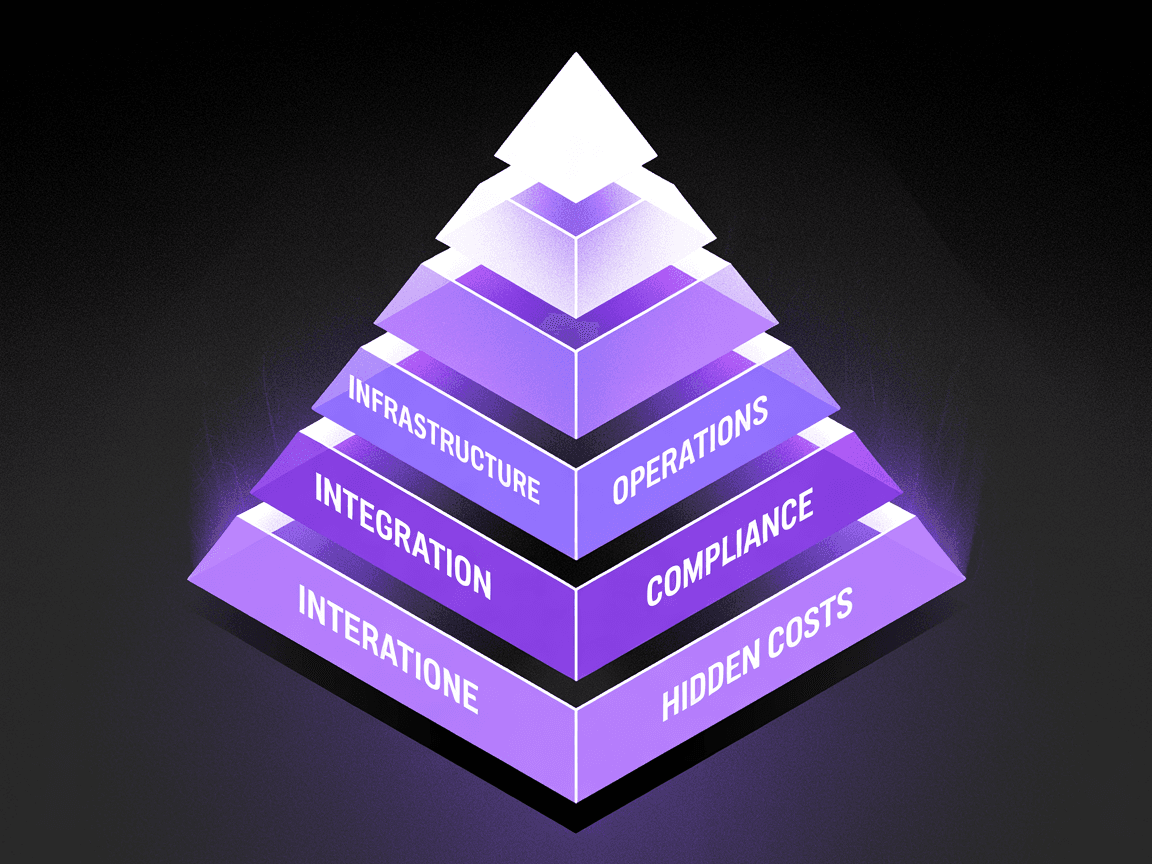
After analyzing over 40 enterprise AI agent deployments across manufacturing, financial services, and SaaS, we have identified five distinct cost layers that account for the full total cost of ownership. Understanding these layers — and their relative weight — is the difference between a business case that survives reality and one that collapses in Q2.
Layer 1: Infrastructure (15-25% of TCO) encompasses LLM API costs, compute for fine-tuning, vector database hosting, cloud infrastructure, and storage. This is the cost most teams estimate accurately because it maps to familiar cloud billing models.
Layer 2: Integration (35-45% of TCO) covers API development, legacy system connectors, data pipeline engineering, testing, and security hardening. This is the budget black hole — the layer where almost every project underestimates by the widest margin.
Layer 3: AgentOps (15-20% of TCO) includes monitoring, observability, prompt engineering iterations, model updates, performance tuning, and incident response. Unlike traditional software, these costs do not decline after year one.
Layer 4: Compliance (10-15% of TCO) addresses EU AI Act risk classification, documentation, audit trail infrastructure, GDPR data protection assessments, and ongoing regulatory monitoring. For European enterprises, this is non-negotiable.
Layer 5: Hidden Costs (5-10% of TCO) captures change management, internal training, opportunity cost during ramp-up, vendor lock-in switching costs, and the organizational overhead of managing a new technology category.
The relative weight of each layer shifts based on industry, use case complexity, and organizational maturity. But the structure remains consistent. Let us examine each layer in detail.
Layer 1: Infrastructure Costs — Models, Compute, and Storage
Infrastructure is the most visible cost layer and, paradoxically, the one that creates the least budget variance. Most finance teams can model cloud costs with reasonable accuracy. The challenge is understanding the specific infrastructure components that AI agents require beyond standard application hosting.
LLM API costs are the headline item, and they vary dramatically based on model selection and call volume. As of early 2026, GPT-4o pricing sits at approximately $2.50 per million input tokens and $10 per million output tokens. Claude 3.5 Sonnet — our recommended model for most enterprise agent workloads — runs at $3 per million input tokens and $15 per million output tokens. For a customer operations agent handling 5,000 interactions per day with an average of 2,000 tokens per interaction, expect monthly LLM API costs of €1,800-€3,500 depending on model choice and prompt efficiency.
But raw API costs are only the beginning. Vector database hosting for retrieval-augmented generation (RAG) adds €200-€800/month depending on index size and query volume. Pinecone, Weaviate, and Qdrant each have distinct pricing models, but a production deployment with 2-5 million embedded documents and sub-200ms query latency typically lands in the €400-€600/month range.
Fine-tuning compute is a periodic rather than ongoing cost, but it is significant. A single fine-tuning run on a 7B parameter model using cloud GPUs costs €500-€2,000 depending on dataset size and training duration. Most production agents require 2-4 fine-tuning cycles per year as data distributions shift and new use cases are added.
Cloud infrastructure — the actual VMs, load balancers, networking, and storage — adds another €500-€1,500/month for a production-grade deployment with proper redundancy. European data residency requirements (more on this in the compliance section) often push these costs 20-30% higher than US-region equivalents due to limited availability zone options.
Networking and data transfer costs are frequently overlooked but add up at scale. Cross-region data transfer for agents that serve multiple European offices, API gateway costs, and SSL certificate management add €100-€300/month. If your architecture requires a private VPC for data sovereignty — increasingly common for German and French enterprises — the premium over standard cloud deployment is 15-25%.
All told, infrastructure costs for a mid-complexity enterprise AI agent run €3,500-€7,000 per month in steady state. Over a 3-year horizon, that is €126,000-€252,000 — significant, but manageable and predictable. This is the layer most teams get approximately right — which is why it is dangerous. Accuracy on 20% of your cost model creates false confidence about the other 80%.
One critical planning note: infrastructure costs are not linear with usage. Token costs scale directly with interaction volume, but compute, storage, and networking have step functions — you will hit capacity thresholds that require infrastructure tier upgrades. Plan for 2-3 step-ups over the first 18 months as agent usage grows from pilot to full production.
Layer 2: Integration Costs — The 40% Budget Black Hole
If there is one number you take away from this article, let it be this: integration consumes 35-45% of total AI agent deployment cost. Not infrastructure. Not the LLM itself. Integration. Connecting your agent to the systems it needs to be useful is where budgets go to die.
The problem is structural. Enterprise AI agents are only valuable when they can read from and write to your existing systems — your ERP, CRM, document management, email, ticketing, and financial platforms. Each of these integrations involves multiple layers of complexity that compound rather than add.
API development and connector engineering is the most obvious integration cost. Building a robust, production-grade connector to SAP S/4HANA, Salesforce, or ServiceNow requires 4-8 weeks of senior engineering time per system. At European senior engineer rates of €120-€160/hour, a single ERP integration runs €40,000-€80,000 before testing. Most agents need 3-5 system integrations, which places the API development cost alone at €120,000-€400,000.
Data pipeline engineering is the hidden multiplier. AI agents do not consume data the way traditional applications do. They need semantically enriched, contextually relevant data delivered in real time. Building the ETL pipelines, embedding workflows, and synchronization mechanisms that keep an agent's knowledge base current adds 30-50% on top of raw API integration costs.
Testing is non-deterministic and therefore more expensive. You cannot write a traditional test suite for a system that may give different outputs for identical inputs. Agent integration testing requires evaluation frameworks, golden datasets, human review pipelines, and regression testing infrastructure that simply does not exist in traditional QA. Budget 15-20% of integration costs specifically for testing.
Security hardening adds a final layer. AI agents that read from and write to production systems require authentication, authorization, rate limiting, audit logging, and data masking that must be implemented per integration. In regulated industries (financial services, healthcare), this security layer alone can cost €20,000-€50,000 per system connection.
Change management at the integration layer is a cost that technical teams rarely model. When you connect an AI agent to Salesforce, the sales team's workflows change. When you connect it to ServiceNow, the support team's escalation paths change. Each integration creates a change ripple that requires training, documentation updates, and a transition period where both old and new workflows run in parallel. Budget €5,000-€15,000 per major integration for change management alone.
When we conduct AI readiness assessments for enterprise clients, integration complexity is the single most common area where initial estimates diverge from reality. A realistic budget allocation for a 3-5 system integration scope is €150,000-€350,000 in year one, with €30,000-€60,000 annually for maintenance and updates. The organizations that manage integration costs effectively are those that prioritize integrations ruthlessly — starting with the one or two systems that deliver the most value, validating the agent's impact, and expanding the integration surface incrementally rather than attempting full connectivity in a single phase.
Layer 3: AgentOps — Monitoring, Maintenance, and Continuous Improvement
Traditional software has a predictable cost curve: high implementation costs that decline into a lower steady-state maintenance budget. AI agents invert this model. Operational costs remain elevated permanently because the underlying systems — LLM models, data distributions, user behaviors — are in constant flux.
AgentOps is the discipline of operating AI agents in production, and it encompasses monitoring, observability, prompt engineering, model management, and performance optimization. It is the AI equivalent of DevOps, and it requires dedicated tooling and personnel.
Observability infrastructure forms the foundation. You need to track latency, token usage, error rates, hallucination frequency, user satisfaction, and task completion rates across every agent interaction. Tools like LangSmith, Arize, or Weights & Biases cost €500-€2,000/month at enterprise scale, but the real cost is the engineering time to instrument your agents and build meaningful dashboards. Budget €15,000-€30,000 for initial observability setup and €1,000-€3,000/month ongoing.
Prompt engineering iterations are a continuous cost that most teams fail to anticipate. Production prompts are not write-once artifacts. They require regular optimization as you discover edge cases, model behavior shifts with provider updates, and business requirements evolve. A dedicated prompt engineer (or a senior engineer spending 30-40% of their time on prompt work) costs €3,000-€6,000/month. Without this investment, agent quality degrades measurably within 4-8 weeks of launch.
Model updates and migration represent a periodic but significant cost. When your LLM provider releases a new model version — which happens every 2-4 months for major providers — you need to evaluate, test, and potentially migrate your agents. Each model migration cycle costs €5,000-€15,000 in engineering time, and skipping migrations means falling behind on cost efficiency and capability improvements.
Performance tuning and optimization is the ongoing work of reducing token costs, improving response times, and increasing task completion rates. This includes techniques like prompt compression, response caching, intelligent routing between models of different sizes, and RAG pipeline optimization. Teams that invest in optimization typically reduce their LLM API costs by 30-50% over 12 months — but the optimization work itself costs €2,000-€5,000/month in engineering time.
The total AgentOps cost for a single production AI agent runs €6,000-€14,000 per month, or approximately €72,000-€168,000 per year. This cost does not decrease significantly over time, which is why it consistently surprises organizations accustomed to traditional software maintenance cost curves.
Layer 4: EU AI Act Compliance Overhead
If you are building AI agents for a European enterprise, your cost model must account for a compliance layer that US-published benchmarks systematically ignore. The EU AI Act, fully enforceable since August 2025, imposes specific obligations on deployers of AI systems that translate directly into engineering and operational costs.
Risk classification is the starting point. Under the EU AI Act, AI systems used in employment decisions, creditworthiness assessments, or access to essential services are classified as high-risk and trigger the full compliance regime. Even agents that fall outside high-risk categories require a basic transparency assessment and documentation. Initial risk classification and legal review costs €10,000-€25,000, and must be repeated whenever the agent's scope changes materially.
Technical documentation under Annex IV of the EU AI Act requires detailed records of training data, model architecture, evaluation metrics, known limitations, and intended use. For a single AI agent, producing and maintaining this documentation requires 80-160 hours of combined engineering and legal time, costing €15,000-€35,000 initially with €5,000-€10,000 annually to keep current.
Audit trail infrastructure is a technical requirement with direct cost implications. Every AI-driven decision must be logged with sufficient detail to reconstruct the reasoning chain. This means storing input data, retrieved context, model outputs, confidence scores, and any human overrides for every interaction. At enterprise interaction volumes, this logging infrastructure costs €500-€2,000/month in storage and compute, plus €10,000-€20,000 to build initially.
GDPR Data Protection Impact Assessments (DPIAs) are mandatory for AI systems that process personal data at scale. Each DPIA costs €8,000-€20,000 in legal and technical review time, and must be updated when processing activities change. For AI agents handling customer data, supplier information, or employee records, DPIA costs are unavoidable.
Ongoing regulatory monitoring is the long tail cost. The EU AI Act is a living regulation, with implementing acts, technical standards, and guidance documents still being published. Budget €1,000-€2,000/month for legal monitoring and €5,000-€15,000 annually for regulatory updates that require technical changes.
In total, compliance costs add 15-20% overhead to an AI agent deployment for European enterprises. For a deployment with a €300K total budget, that translates to €45,000-€60,000 in compliance-specific costs. This is not optional spend — it is the cost of operating legally in the European market. Our governance framework guide provides a detailed compliance checklist.
Worked Example: A Customer Operations Agent — 3-Year TCO
Theory is useful, but CFOs want numbers. Here is a complete 3-year TCO model for a real-world use case: an AI agent that handles Tier-1 customer support for a mid-market European SaaS company with 15,000 customers and approximately 3,000 support tickets per month.
Year 1 costs (implementation + first year operations): approximately €185,000
- Infrastructure setup and first-year hosting: €48,000 (€4,000/month average)
- Integration engineering (Zendesk, Salesforce, internal knowledge base): €65,000
- AgentOps tooling and initial monitoring setup: €22,000
- EU AI Act compliance (risk classification, documentation, DPIA): €28,000
- Change management and internal training: €12,000
- Contingency (10%): €10,000
Year 2 costs (steady-state operations): approximately €95,000
- Infrastructure and hosting: €48,000 (€4,000/month)
- AgentOps and continuous improvement: €24,000 (€2,000/month)
- Integration maintenance and updates: €12,000
- Compliance maintenance and regulatory updates: €8,000
- Contingency (5%): €3,000
Year 3 costs (optimized operations): approximately €88,000
- Infrastructure and hosting: €42,000 (reduced via optimization to €3,500/month)
- AgentOps and continuous improvement: €22,000
- Integration maintenance: €12,000
- Compliance maintenance: €8,000
- Contingency (5%): €4,000
3-Year Total: approximately €368,000
Now compare this to the naive estimate that many organizations start with: LLM API cost (€3,000/month) plus a one-time implementation fee (€50,000) equals €158,000 over three years. The real cost is 2.3x the naive estimate — almost exactly in line with Gartner's 2.8x average overrun figure.
The critical insight is not that AI agents are expensive. It is that the cost distribution is radically different from what most organizations expect. Infrastructure — the most visible cost — represents only 38% of the 3-year total. Integration, AgentOps, and compliance together account for 62% of costs, and these are the categories most often underbudgeted.
For teams evaluating their first AI agent deployment, our six-week playbook provides a phased approach that surfaces these costs early rather than late.
Building a Business Case Your CFO Will Approve
A realistic cost model is necessary but not sufficient. To secure budget for an AI agent deployment, you need a business case that quantifies the return — and does so in terms your CFO already understands.
Start with the cost of the current process. For our customer operations example, calculate: (number of Tier-1 tickets per month) x (average handling time in hours) x (fully loaded hourly cost of support staff). For 3,000 tickets/month at 25 minutes average handling time and €45/hour fully loaded cost, the current process costs approximately €56,000/month or €672,000/year.
Model the agent's impact conservatively. Do not claim 90% automation on day one. A realistic ramp looks like this: Month 1-3: 30% automation rate. Month 4-6: 50% automation rate. Month 7-12: 65-70% automation rate. At a 65% steady-state automation rate, the agent handles 1,950 tickets/month autonomously, saving approximately €36,000/month in direct labor costs.
Calculate the payback period. With year-one costs of €185,000 and monthly savings that ramp from €17,000 (month 1-3) to €36,000 (month 7+), the cumulative break-even point lands at approximately month 11. This is a payback period that most enterprise CFOs will accept for a technology investment.
Present risk-adjusted returns. Apply a 70% confidence factor to your savings estimates to account for implementation delays, lower-than-expected automation rates, and scope changes. Even at 70% confidence, the 3-year NPV of our example deployment is positive by €350,000-€500,000 at a 10% discount rate.
Frame the total picture. Beyond direct labor savings, quantify secondary benefits: faster response times (from 4 hours to 3 minutes for Tier-1), improved CSAT scores, reduced agent burnout and turnover, and 24/7 availability without shift premiums. These secondary benefits are harder to dollarize but they often tip the decision for skeptical executives.
The business cases that fail are the ones that present optimistic savings against unrealistic cost estimates. The ones that succeed present conservative savings against honest cost models. Use the five-layer TCO framework in this article to build the cost side, and you will have a business case that survives its first encounter with financial scrutiny.
Common pitfalls in business case construction deserve explicit mention. Do not annualize savings from a pilot that has been running for two weeks — wait for 90 days of production data before extrapolating. Do not exclude compliance costs to make the numbers work — the CFO will discover them later, and your credibility will not survive. Do not compare your deployment to vendor case studies from US-based companies that do not face EU AI Act overhead. And do not assume that headcount reduction is the only path to ROI — in many cases, the business case is stronger when framed as capacity expansion (handling 3x the volume with the same team) rather than headcount reduction.
If you need help building a board-ready business case for your specific use case, contact our strategy team for a complimentary TCO assessment.