The August 2026 Deadline: What Annex III Means for AI Agents
The EU AI Act entered into force on August 1, 2024. Its provisions are being phased in over three years, but the date that matters most for enterprise AI deployments is August 2, 2026 — when the obligations for high-risk AI systems under Annex III become enforceable. This is not a soft deadline. Non-compliance carries fines of up to €35 million or 7% of global annual turnover, whichever is higher.
Annex III defines eight categories of high-risk AI systems. Several map directly to common enterprise AI agent use cases. Category 1 (Biometrics): AI systems used for identity verification in customer onboarding or access control. Category 3 (Education and vocational training): AI systems that evaluate students or determine access to educational programs. Category 4 (Employment, workers management, and access to self-employment): AI systems used for recruitment screening, employee performance evaluation, task allocation, or termination decisions. Category 5 (Access to essential private and public services): AI systems used for credit scoring, insurance pricing, or determining eligibility for public benefits. Category 6 (Law enforcement): AI systems used in crime analytics or risk assessment. Category 8 (Administration of justice and democratic processes): AI systems used in legal research or judicial assistance.
For most enterprise AI agent deployments, Category 4 (Employment) and Category 5 (Essential services) are the critical ones. If your AI agent screens resumes, routes customer service inquiries based on account value, determines warranty eligibility, or assists with loan application decisions, you are likely operating a high-risk system under Annex III.
The requirements for high-risk systems under Articles 8-15 are substantial: a risk management system (Article 9), data governance (Article 10), technical documentation (Article 11), record-keeping (Article 12), transparency (Article 13), human oversight (Article 14), and accuracy, robustness, and cybersecurity (Article 15). This article provides the operational playbook for implementing these requirements.
It is worth noting what is not high-risk. AI agents that answer product FAQs, summarize documents, generate reports, or assist with internal research typically fall outside Annex III — unless they materially influence decisions about individuals' access to services, employment, or rights. The classification depends on the agent's purpose and impact, not its underlying technology. A GPT-4-powered agent is not inherently high-risk; a GPT-4-powered agent that screens job applications is.
The timeline pressure is real. Building a governance framework, implementing audit trails, establishing oversight mechanisms, and documenting everything takes 3-6 months for a mid-size enterprise. With August 2026 enforcement, organizations that have not started by March 2026 are at serious risk of non-compliance. Those that act now have time to implement thoughtfully rather than reactively.
Building Your AI System Inventory
You cannot govern what you do not know exists. The first step in any AI governance program is a comprehensive inventory of all AI systems deployed or under development across the organization. This is harder than it sounds — AI has a way of proliferating beyond the visibility of central IT.
What to catalog. Every AI system, model, or AI-powered feature, including: production AI agents and autonomous systems, ML models in production (recommendation engines, fraud detection, forecasting), AI features embedded in third-party software (your CRM's lead scoring, your HR platform's resume screening, your ERP's demand forecasting), internal tools using LLM APIs (even if "just for productivity"), and pilot projects and proof-of-concepts that process real data.
The third category — AI embedded in third-party software — is where most organizations have blind spots. When Salesforce Einstein scores your leads, that is an AI system in your environment. When SAP uses ML for demand planning, that is an AI system making decisions that affect your business. Your inventory must include these, because under the EU AI Act, deployers (not just providers) have obligations for high-risk systems.
The inventory template should capture for each system: a unique identifier, system name and description, the AI techniques used (LLM, ML model, rule-based hybrid), the provider (internal, vendor name), the business process it supports, the data it processes (categories, volume, sensitivity), the decisions it influences or makes, the affected individuals (employees, customers, public), the current risk classification (to be assessed), the system owner (business unit and named individual), the deployment date, and the last review date.
How to conduct the inventory. Start with IT systems records and procurement data — any contract with AI, ML, or analytics vendors. Then survey business unit leaders with a standardized questionnaire. Follow up with technical teams who may have deployed LLM API integrations informally. Check cloud billing for AI-related API charges (OpenAI, Anthropic, Google AI, AWS Bedrock, Azure OpenAI). Review internal development repositories for ML/AI projects.
In our experience at Korvus Labs, the inventory process takes 2-3 weeks for a mid-size enterprise (500-5,000 employees) and reveals 40-60% more AI systems than leadership initially estimated. The typical enterprise in this range has 15-35 distinct AI systems when all third-party AI features are counted.
Maintaining the inventory is as important as building it. Establish a policy that any new AI system deployment — including new features in existing vendor software — must be registered in the inventory before going live. Assign a central owner (typically the AI Risk Officer or DPO) responsible for keeping the inventory current. Review the complete inventory quarterly.
This inventory becomes the foundation for everything that follows: risk classification, audit trail requirements, oversight mechanisms, and documentation obligations. Without it, governance is theoretical. With it, governance is operational.
Risk Classification for Agentic AI Systems
With your inventory complete, each AI system must be classified into the EU AI Act's risk categories. The classification determines which obligations apply and how intensive your governance must be.
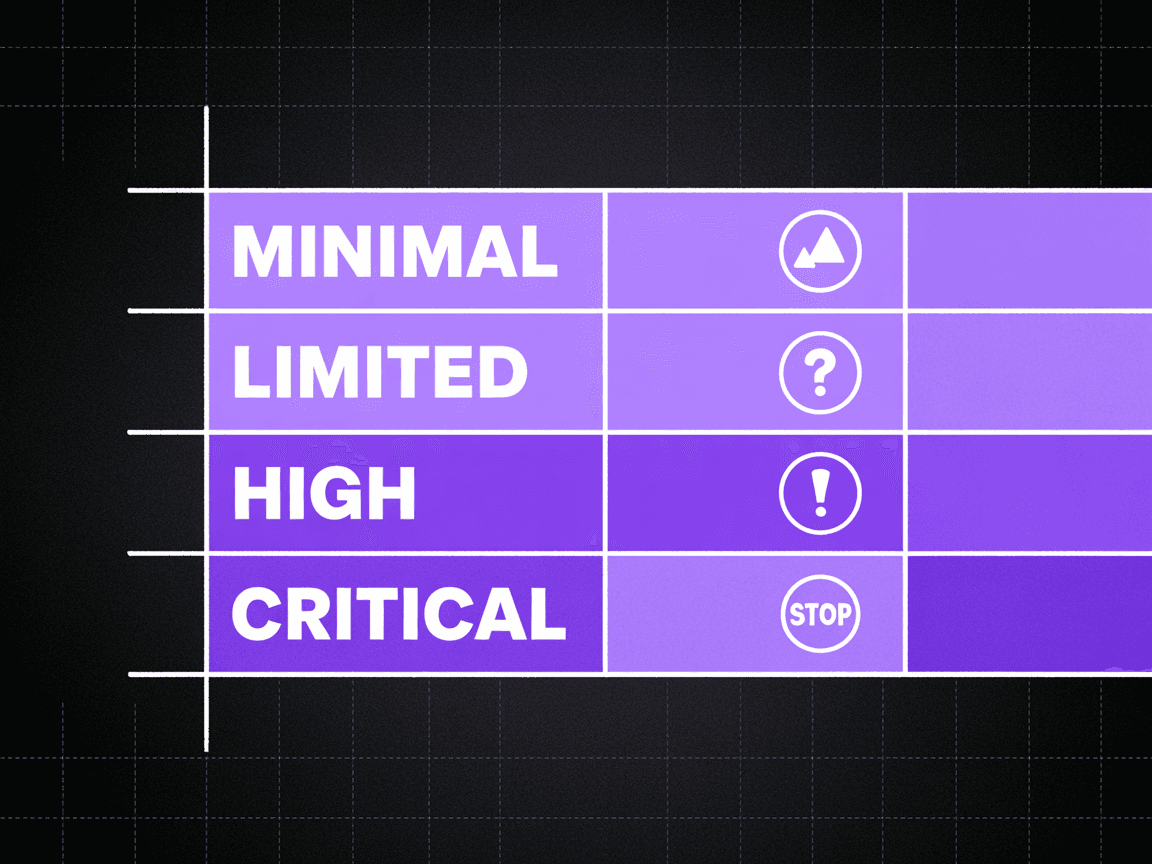
The four risk levels under the EU AI Act are: Prohibited (Article 5) — AI systems that are banned outright, including social scoring, real-time biometric surveillance (with exceptions), and manipulative AI. High-risk (Annex III, Articles 6-7) — AI systems in the eight categories listed above, subject to the full requirements of Articles 8-15. Limited risk (Article 50) — AI systems with transparency obligations, primarily chatbots and deepfake generators that must disclose their AI nature. Minimal risk — everything else, with no specific obligations beyond voluntary codes of practice.
For AI agents, the classification challenge is that the same underlying technology can fall into different risk categories depending on its application. An AI agent using GPT-4o is minimal risk when it summarizes meeting notes. It is limited risk when it interacts with customers (transparency obligation to disclose AI nature). It becomes high-risk when it screens job applications or determines credit eligibility.
The classification decision framework we recommend has five questions:
- Does the AI system fall within any Annex III category? If yes, it is presumptively high-risk. Proceed to question 2.
- Does the AI system's output materially influence decisions about individuals' access to employment, services, education, or rights? If yes, confirm high-risk classification.
- Is the AI system's role purely assistive — providing information that a human decision-maker evaluates independently before acting? If yes, and if the human has genuine discretion and competence to override, the system may fall outside high-risk under Article 6(3), which exempts AI systems that perform narrow procedural tasks, improve the result of previously completed human activities, or detect decision-making patterns without replacing human assessment.
- Does the AI system interact directly with individuals (customers, employees, public)? If yes, limited risk transparency obligations apply at minimum.
- Does the AI system process personal data? If yes, GDPR obligations apply in addition to AI Act requirements.
For AI agents specifically, the classification is often high-risk because agents do not just provide information — they take actions. An agent that automatically processes refunds, modifies customer accounts, escalates or deprioritizes support tickets, or allocates tasks to employees is making operational decisions that affect individuals. The "purely assistive" exemption under Article 6(3) typically does not apply to autonomous agent systems precisely because they are designed to act, not just advise.
Our recommendation: classify conservatively. If there is any doubt about whether an AI agent is high-risk, treat it as high-risk. The cost of over-classification is additional governance overhead (manageable). The cost of under-classification is regulatory non-compliance (potentially catastrophic). We have worked with enterprises that initially classified 8 systems as high-risk during initial assessment, then refined to 5 after deeper legal analysis. Starting high and narrowing down is safer than the reverse.
Document the classification decision for each system with: the assessor's name and qualifications, the date of assessment, the Annex III category considered, the rationale for the classification decision, any external legal opinions obtained, and the next scheduled review date (we recommend annual re-classification or upon any significant change to the system's functionality).
Designing Audit Trails for Non-Deterministic Systems
Traditional enterprise audit trails assume deterministic systems: the same input always produces the same output, and the system's decision logic can be reconstructed from its configuration. AI agents violate both assumptions. The same input can produce different outputs depending on the model's state, the context window contents, and inference-time sampling. The decision logic is encoded in billions of neural network parameters, not human-readable rules.
This does not mean audit trails are impossible — it means they must be designed differently. Article 12 of the EU AI Act requires that high-risk AI systems have logging capabilities that enable recording of events ("logs") relevant to identifying risks, facilitating post-market monitoring, and enabling traceability of the system's operations.
Layer 1: Input Logging. Capture the complete input to the AI system: the user's request, the system prompt (versioned), all context injected via RAG or tool calls, the model identifier and version, and any configuration parameters (temperature, max tokens, etc.). Input logs must be stored immutably — once written, they cannot be modified or deleted during the retention period. Timestamp every entry with UTC time from a synchronized clock source.
Layer 2: Reasoning Trace Capture. This is where agent audit trails diverge most sharply from traditional systems. An agent's reasoning process involves multiple steps: initial interpretation of the request, planning which tools to use, executing tool calls, receiving results, re-evaluating, and generating a response. Each step must be captured. For LangChain/LangGraph-based agents, this means logging every node execution in the graph, every tool invocation with its parameters and results, and every intermediate LLM call with its prompt and response. The reasoning trace is the AI equivalent of showing your work — it allows reviewers to understand not just what the agent decided, but how it reached that decision.
Layer 3: Action Logging. Every action the agent takes on external systems must be logged independently of the agent's own records. When the agent modifies a customer record, the CRM should log the modification with the agent's service account as the actor. When the agent sends an email, the email system should log the send event. This creates a corroborating record that can be cross-referenced with the agent's reasoning trace. Discrepancies between what the agent reports doing and what system logs show it actually did indicate a serious problem that requires immediate investigation.
Layer 4: Output Logging. Capture the complete output delivered to the user or downstream system: the response text, any structured data generated, confidence scores, and the decision to respond autonomously versus escalate. Also log any output filtering or modification applied after the LLM generates its response (PII redaction, content policy filtering, format transformation).
Layer 5: Confidence and Uncertainty Scoring. For every decision the agent makes, log a confidence score. This serves two purposes: it provides a quantitative basis for audit ("the agent was 0.94 confident in this classification") and it enables aggregate analysis ("how often do low-confidence decisions turn out to be incorrect?"). Confidence scores should be calibrated — a score of 0.9 should mean the agent is correct approximately 90% of the time. Calibration must be tested and documented as part of the system's accuracy requirements under Article 15.
Storage and retention. Audit logs for high-risk AI systems should be retained for a minimum of the system's lifetime plus 10 years, per the general requirements for technical documentation under Annex IV. In practice, we recommend structuring logs in three tiers: hot storage (30 days, full-resolution, immediately queryable) in Elasticsearch or equivalent, warm storage (1 year, full-resolution, queryable within minutes) in compressed object storage, and cold storage (10+ years, archived, retrievable within hours) in immutable archival storage. Total storage costs for a mid-volume agent (10,000 interactions/day) run approximately €200-€500/month across all tiers.
Practical implementation. We implement audit trails using OpenTelemetry for distributed tracing (capturing the reasoning trace across service boundaries), a structured logging framework that outputs JSON events to a centralized log aggregator, and a separate audit database that stores the combined five-layer record in an append-only, tamper-evident format. The technical architecture for this logging infrastructure is a standard component of every agent deployment we build.
Human Oversight Mechanisms That Actually Work
Article 14 of the EU AI Act requires that high-risk AI systems be designed to allow effective human oversight. The article specifies that oversight should enable the human to: fully understand the system's capabilities and limitations, properly monitor operation, detect anomalies and malfunctions, correctly interpret outputs, and decide to override, interrupt, or shut down the system.
In practice, most organizations implement human oversight as a checkbox exercise — a dashboard nobody looks at, an approval workflow that becomes a rubber stamp, or a quarterly review that reviews aggregate statistics without examining individual decisions. This does not satisfy Article 14, and more importantly, it does not actually govern the AI system.
Effective oversight requires four mechanisms:
Mechanism 1: Confidence-Based Approval Workflows. Configure the agent with a confidence threshold below which it cannot act autonomously. For high-risk decisions (credit approval, employee evaluation, service eligibility), set this threshold aggressively — 0.95 or higher. When the agent's confidence falls below the threshold, it pauses execution and routes the decision to a qualified human reviewer with its complete reasoning trace. The reviewer sees: the agent's proposed action, its confidence score, the reasoning chain, the data it consulted, and any conflicting information it identified. The reviewer then approves, modifies, or rejects the proposed action. This is not a binary approve/reject — the reviewer must have the ability to modify the agent's output before it takes effect.
Mechanism 2: Statistical Sampling Review. Even when the agent operates above the confidence threshold, a random sample of decisions should be reviewed by humans. We recommend a 5% random sample for high-risk systems, reviewed weekly. The reviewer evaluates each sampled decision for accuracy, fairness, and appropriateness. Findings feed back into the agent's system prompt, knowledge base, and threshold calibration. This catches systematic errors that individual confidence scores miss — for example, an agent that is consistently confident but subtly biased in a particular direction.
Mechanism 3: Anomaly Detection and Alerting. Automated monitoring should flag unusual patterns: sudden changes in the distribution of agent decisions (e.g., approval rates shifting by more than 5% week-over-week), clusters of low-confidence decisions in a specific category, unusual error patterns, and significant deviations from expected behavior on known test cases. Alerts should go to the system owner and the AI Risk Officer, with defined response procedures and timelines. Our recommended alerting framework includes three severity levels: informational (review within 5 business days), warning (review within 24 hours), and critical (immediate review, agent paused until resolved).
Mechanism 4: Override and Kill Switch. Every AI agent must have a documented procedure for immediate shutdown. This is not just an emergency button — it is a tested, rehearsed procedure that the operations team can execute in under 5 minutes. The kill switch must: stop the agent from taking new actions, preserve all in-progress interactions, route any pending decisions to human agents, log the shutdown event with the triggering reason, and send notifications to all relevant stakeholders. Test the kill switch quarterly with an announced drill.
Beyond these four mechanisms, the humans performing oversight must be qualified. Article 14(4) explicitly requires that individuals assigned to human oversight have the "necessary competence, training, and authority" to fulfill their role. A junior support agent rubber-stamping agent decisions does not satisfy this requirement. Oversight personnel must understand the AI system's capabilities and limitations, have domain expertise in the decisions being reviewed, and have the organizational authority to override or shut down the system. Document their qualifications and training as part of your governance records.
For a deeper dive into human oversight design patterns, see our article on human-in-the-loop architecture, which covers four production-tested patterns with implementation details.
Bias Testing and Fairness Audits for AI Agents
Article 10(2)(f) of the EU AI Act requires examination of data for possible biases that could lead to discrimination. For high-risk AI systems, this is not optional and not vague — it requires documented testing with specific methodologies and outcomes.
What bias looks like in AI agents. Agent bias is not always obvious. A customer support agent might consistently provide faster, more detailed responses to inquiries written in formal English compared to informal or non-native English. A recruitment screening agent might favor candidates whose resumes use formatting conventions common in certain cultural contexts. An insurance claims agent might require more documentation from claimants in certain postal code areas. These patterns emerge from biases in training data, reinforced by the agent's reward signals and system prompt design.
Testing methodology for enterprise AI agents:
Step 1: Define protected characteristics. Under EU law (Employment Equality Directive 2000/78/EC, Racial Equality Directive 2000/43/EC, and GDPR Article 9), protected characteristics include: race and ethnic origin, gender and gender identity, age, disability, sexual orientation, religion or belief, and political opinion. Your bias testing must cover at minimum the characteristics relevant to your agent's domain.
Step 2: Create diverse test datasets. Build test inputs that systematically vary protected characteristics while holding all other variables constant. For a customer support agent, this means creating identical support requests but varying the customer name (reflecting different ethnic backgrounds), the language register (formal vs. informal), and the communication style. For a recruitment agent, use synthetic resumes with identical qualifications but varying names, university locations, and extracurricular activities that correlate with demographics. We recommend a minimum of 200 test cases per protected characteristic, with at least 50 per subgroup within each characteristic.
Step 3: Measure outcome disparities. Run the test dataset through the agent and measure outcomes across groups. Key metrics include: demographic parity (are outcomes distributed equally across groups?), equalized odds (are true positive and false positive rates equal across groups?), individual fairness (do similar individuals receive similar outcomes?), and treatment quality parity (for support agents: are response length, detail, helpfulness, and tone consistent across groups?). The EU AI Act does not specify exact thresholds, but regulatory guidance and case law suggest that outcome disparities exceeding 5-10% across protected groups warrant investigation and mitigation.
Step 4: Root cause analysis. When disparities are identified, trace them to their source. Common causes include: biased training data (the underlying LLM reflects societal biases), biased system prompt (instructions that inadvertently favor certain communication styles), biased knowledge base (reference materials that lack diversity), and biased evaluation criteria (metrics that correlate with protected characteristics). The root cause determines the mitigation: retraining, prompt engineering, knowledge base diversification, or metric redesign.
Step 5: Mitigation and retesting. Implement targeted mitigations and retest. Common mitigation strategies include: system prompt modifications that explicitly instruct fairness ("treat all customers with equal thoroughness regardless of language style or name"), output calibration that adjusts for detected biases, retrieval diversification that ensures the knowledge base does not systematically favor certain groups, and human review requirements for decisions in categories where bias was detected.
Step 6: Documentation. Document the entire process: test methodology, test datasets (anonymized if necessary), results, identified disparities, root causes, mitigations applied, retest results, and the assessor's conclusions. This documentation is required under Article 11 and Annex IV, and it will be the primary evidence reviewed by regulators or auditors.
Frequency: Conduct full bias audits before initial deployment, after any significant model update or system prompt change, quarterly for high-risk systems, and annually at minimum for all AI systems. In between formal audits, the statistical sampling review (described in the oversight section) should include bias-related checks as a standing component.
The Governance Operating Model: Roles, Committees, and Cadences
A governance framework without an operating model is a document that sits on a shelf. Converting your framework into sustained organizational practice requires defined roles, a committee structure, and regular cadences.
Role 1: AI Risk Officer. This is the central role in your governance operating model. The AI Risk Officer owns the AI system inventory, ensures risk classifications are current, coordinates audit and compliance activities, reports to executive leadership and the board, and serves as the primary liaison with regulatory authorities. In smaller organizations, this role may be combined with the DPO role. In larger organizations, it should be a dedicated position reporting to the CRO or General Counsel. Required competencies: understanding of AI technology, EU regulatory landscape, risk management frameworks, and enterprise governance.
Role 2: Model Owners. Each AI system in the inventory should have a designated Model Owner — typically the business unit leader or product manager responsible for the system's business purpose. The Model Owner is accountable for: ensuring the system operates within its approved scope, reviewing oversight reports and acting on findings, approving changes to the system's configuration, and escalating issues to the AI Risk Officer. Model Owners do not need deep technical AI expertise, but they must understand their system's capabilities, limitations, and risk profile.
Role 3: AI Engineers / MLOps Team. The technical team responsible for implementing and maintaining the governance infrastructure: audit trail systems, monitoring dashboards, bias testing pipelines, and kill switch procedures. They translate governance requirements into technical controls. They maintain the documentation required under Article 11 and Annex IV. They are the first responders when monitoring detects anomalies.
Role 4: Data Stewards. Responsible for the data governance requirements under Article 10: data quality, data lineage, data access controls, and data bias assessment. In organizations with existing data governance programs, these roles already exist and need expanded responsibilities. In organizations without them, establishing data stewardship is a prerequisite for AI governance.
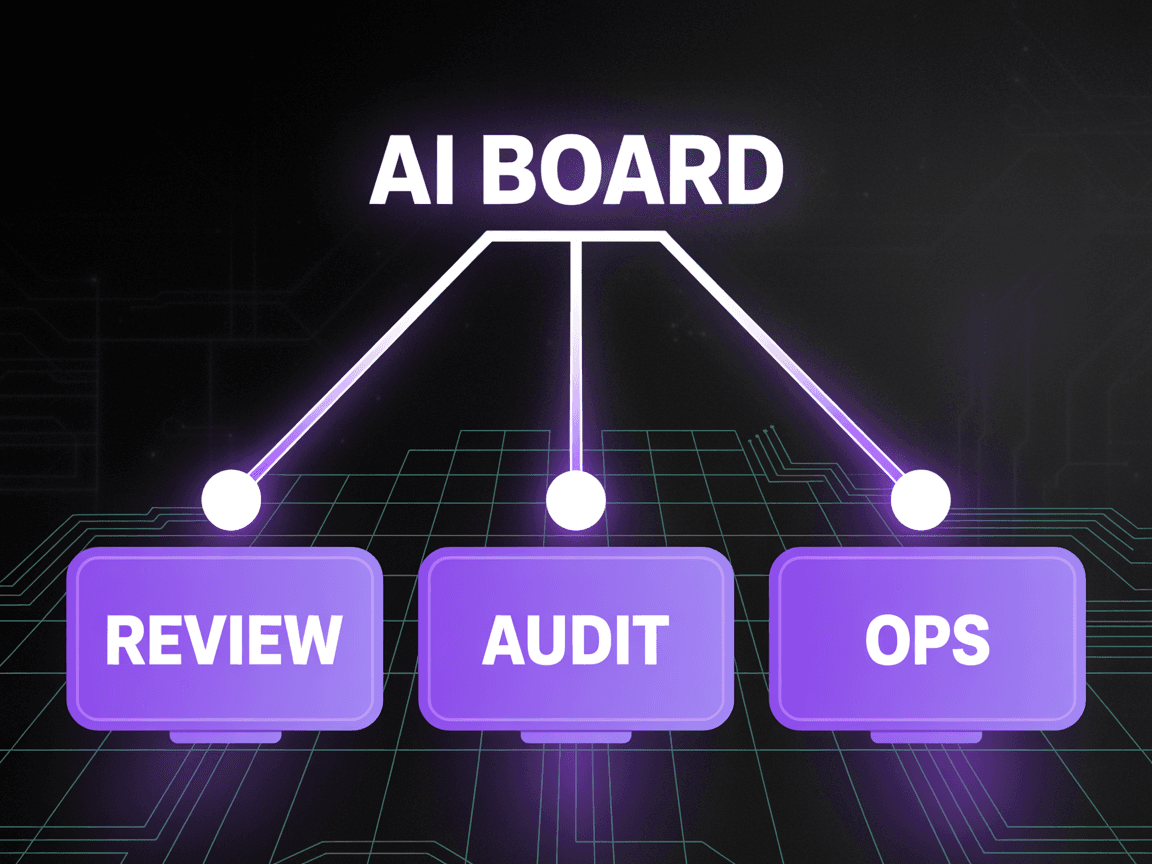
The AI Governance Committee is the organizational body that provides strategic direction and executive oversight for AI governance. Composition should include: the AI Risk Officer (chair), the DPO, the CISO or IT Security lead, 2-3 Model Owners representing the highest-risk systems, a legal representative, and an external advisor (optional but recommended for the first 12-18 months). The committee meets quarterly with the following standing agenda: review of the AI system inventory (additions, retirements, reclassifications), review of audit and oversight findings across all high-risk systems, review of bias testing results, review of any incidents or near-misses, regulatory updates and their implications, and approval of new high-risk AI system deployments.
Cadence structure across the organization:
- Daily: Automated monitoring checks; alert response per defined SLAs.
- Weekly: Statistical sampling review of high-risk agent decisions (5% sample). Model Owner review of their system's key metrics dashboard.
- Monthly: AI Risk Officer reviews aggregate metrics across all AI systems. Incident review for any issues in the preceding month. Knowledge base and system prompt change review.
- Quarterly: AI Governance Committee meeting (full standing agenda). Bias testing cycle for high-risk systems. Kill switch drill. Regulatory landscape review.
- Annually: Full AI system inventory refresh. Re-classification assessment for all systems. Governance framework review and update. External audit (recommended for high-risk systems). Board-level AI risk report.
Incident response. Your governance operating model must include an AI incident response procedure. When something goes wrong — a biased outcome, a data breach, an agent acting outside its scope, a customer complaint about AI-generated content — the response procedure should define: who is notified (and within what timeframe), who has authority to pause or shut down the system, how the investigation is conducted, how affected individuals are notified, how the incident is documented, and what corrective actions are required before the system resumes operation. We recommend modeling your AI incident response on your existing cybersecurity incident response procedure, adapted for AI-specific scenarios.
Budget reality. Establishing and maintaining an AI governance program costs real money. For a mid-size enterprise with 15-25 AI systems, expect annual governance costs of €150,000-€350,000 including: partial FTE allocation for the AI Risk Officer (€80,000-€120,000), technical infrastructure for audit trails and monitoring (€20,000-€40,000 annually), bias testing tools and external audit support (€25,000-€50,000), committee time and administrative support (€15,000-€30,000), and training and awareness programs (€10,000-€25,000). This is significant but modest compared to the cost of non-compliance (up to 7% of global turnover) or the reputational damage of a high-profile AI governance failure.
Practical Framework Template: Your First 90 Days
This 90-day implementation plan assumes you are starting from a position of limited AI governance maturity — which is where most European enterprises are today. The plan is designed to achieve minimum viable compliance by the end of month 3, with continuous improvement thereafter.
Month 1 (Days 1-30): Inventory, Classification, and Foundation
Week 1-2: AI System Inventory. Conduct the comprehensive inventory process described earlier. Engage IT, procurement, and business unit leaders. Identify all AI systems including third-party AI features. Target: complete inventory of all AI systems with basic metadata (name, owner, purpose, data processed, affected individuals).
Week 3: Risk Classification. Apply the five-question classification framework to each system in the inventory. Engage legal counsel for ambiguous cases. Target: every system classified as prohibited, high-risk, limited risk, or minimal risk, with documented rationale.
Week 4: Gap Analysis and Prioritization. For each high-risk system, assess current compliance against Articles 8-15 requirements. Identify the largest gaps. Prioritize remediation efforts based on risk exposure and implementation complexity. Target: prioritized remediation backlog with estimated effort for each item.
Deliverables by Day 30: Complete AI system inventory. Risk classification for all systems. Gap analysis report. Prioritized remediation plan. Executive briefing document.
Month 2 (Days 31-60): Audit Trails, Monitoring, and Oversight
Week 5-6: Audit Trail Implementation. Implement the five-layer audit trail architecture for the top 2-3 highest-risk AI systems. Deploy logging infrastructure (OpenTelemetry, structured logging, immutable storage). Verify that input, reasoning, action, output, and confidence logs are captured correctly. Target: production audit trails operational for priority systems.
Week 7: Monitoring and Alerting. Deploy monitoring dashboards showing key metrics for each AI system: decision distribution, confidence scores, error rates, and escalation rates. Configure three-tier alerting (informational, warning, critical). Test alert routing and response procedures. Target: operational monitoring with tested alerting.
Week 8: Human Oversight Mechanisms. Implement confidence-based approval workflows for high-risk decisions. Establish statistical sampling review process (5% weekly sample). Document and test the kill switch procedure for each high-risk system. Assign oversight personnel with documented qualifications. Target: all four oversight mechanisms operational for priority systems.
Deliverables by Day 60: Operational audit trails for priority systems. Monitoring dashboards and alerting. Documented and tested oversight mechanisms. Kill switch procedures tested and verified.
Month 3 (Days 61-90): Governance Body, First Review, and Documentation
Week 9-10: Governance Body Establishment. Appoint or formally designate the AI Risk Officer. Identify and engage Model Owners for each AI system. Establish the AI Governance Committee with defined membership and charter. Draft the committee charter, meeting cadence, and standing agenda. Target: governance body formally established with first meeting scheduled.
Week 11: Initial Bias Testing. Conduct the first bias testing cycle for the highest-risk AI system. Create test datasets, run tests, document results, and implement any immediate mitigations. This establishes the methodology and baseline for ongoing testing. Target: completed bias audit for at least one high-risk system.
Week 12: First Governance Review and Documentation. Hold the inaugural AI Governance Committee meeting. Review the inventory, classifications, audit trail status, oversight mechanisms, and bias testing results. Identify gaps and assign remediation actions. Compile all documentation into a structured governance dossier. Target: first committee meeting completed; governance dossier assembled.
Deliverables by Day 90: Formal AI governance body with charter and cadence. Initial bias testing report. First governance review meeting minutes. Comprehensive governance dossier. Ongoing improvement roadmap for months 4-12.
What comes after 90 days. The 90-day plan establishes the foundation. Months 4-6 should focus on extending audit trails and oversight to all high-risk systems, conducting bias testing across all high-risk systems, training all Model Owners and oversight personnel, and preparing for external audit readiness. Months 7-12 should focus on maturing the governance program: refining processes based on lessons learned, automating routine compliance checks, building institutional knowledge, and preparing the annual governance report.
If your organization needs structured support for this implementation, Korvus Labs offers a 90-day governance implementation engagement that provides the technical infrastructure, process design, and hands-on support to stand up your AI governance program. We have guided enterprises through this process across financial services, healthcare, and public sector contexts, and we know where the common pitfalls are.