
The Autonomy Spectrum: From Fully Manual to Fully Autonomous
Every conversation about human-in-the-loop AI agents eventually stalls on the same question: how much autonomy should the agent have? Too little, and you have built an expensive autocomplete. Too much, and you are one hallucination away from a compliance incident that lands on the CEO's desk.
The answer is not binary. It lives on a five-level spectrum that we use with every enterprise client to frame the autonomy conversation in concrete terms.
Level 1: Human-Only with AI Assistance. The human makes every decision. The agent provides suggestions, drafts, or analysis, but takes no action. Think of a support agent who sees AI-generated response suggestions but types every reply manually. Automation rate: effectively 0%. Use case: initial deployment phase, or domains where every decision carries material legal risk.
Level 2: AI-Suggested, Human-Selected. The agent proposes 2-3 options with reasoning. The human selects one or modifies it. The agent executes the selected option. This is the pattern behind most "copilot" products. Automation rate: 20-40% of human effort saved. Use case: complex decision-making where human judgment is irreplaceable but preparation is time-consuming.
Level 3: AI-Executes with Pre-Approval. The agent prepares a complete action plan and executes it after human approval. The human reviews a summary and clicks approve or reject. No approval within a defined SLA triggers escalation. Automation rate: 60-75%. Use case: financial transactions, contract modifications, customer data changes — anything with material consequences that are difficult to reverse.
Level 4: AI-Executes with Post-Hoc Oversight. The agent acts autonomously in real time. Humans review a sample of decisions after the fact through dashboards and audit logs. Anomalies trigger alerts. Automation rate: 85-95%. Use case: high-volume, time-sensitive operations where pre-approval would create unacceptable latency — Tier-1 support, invoice classification, routine data processing.
Level 5: Fully Autonomous. The agent operates without human oversight. No review, no dashboard, no alerts unless something breaks catastrophically. Automation rate: 99%+. Use case: almost none in enterprise today. Even the most mature deployments we have seen maintain at least Level 4 oversight.
The critical insight from deploying agents across 30+ enterprise environments is this: most production agents should operate at Level 3 or Level 4. Level 3 for high-stakes, lower-volume decisions. Level 4 for high-volume, lower-stakes operations. The specific level is not a permanent architectural decision — it is a dial you turn based on accumulated confidence data. Many of our clients start at Level 2 and progress to Level 4 within 8-12 weeks as they build trust through measured performance.
The EU AI Act reinforces this gradient. High-risk AI systems under the Act require "effective oversight by natural persons" — which maps directly to Level 3-4 with documented monitoring procedures. Level 5 autonomy is effectively non-compliant for any high-risk classification. Understanding where your agent sits on this spectrum is the foundation for every architectural decision that follows.
Pattern 1: Confidence-Based Escalation
Confidence-based escalation is the workhorse pattern of enterprise AI agents. The concept is straightforward: the agent scores its own confidence for every decision, and routes low-confidence decisions to a human reviewer while executing high-confidence decisions autonomously. In practice, implementing this well is the difference between an agent that automates 40% of work and one that automates 90%.
The architecture has four components. First, a confidence scoring module that evaluates every agent decision on a 0-1 scale. Second, a threshold engine that maps confidence scores to actions: auto-execute above the upper threshold, escalate below the lower threshold, and apply additional validation checks in the middle band. Third, a human review queue with prioritization, SLA tracking, and context presentation. Fourth, a feedback loop that uses human review outcomes to recalibrate confidence scoring over time.
The confidence score itself is not a single number — it is a composite. For a customer support agent, we typically combine four signals: semantic similarity between the incoming query and known resolution patterns (weighted 30%), model output probability derived from logprob analysis of the LLM's response (weighted 25%), entity extraction confidence indicating whether the agent correctly identified the customer, product, and issue type (weighted 25%), and policy compliance check confirming the proposed action does not violate business rules (weighted 20%).
Threshold calibration follows a specific protocol. During the first two weeks of deployment, we set the auto-execute threshold high enough that only 10-20% of decisions are automated. Every decision — automated and escalated — is reviewed by humans, generating labeled data. After two weeks, we have typically accumulated 2,000-5,000 labeled decisions, enough to plot a precision-recall curve and identify the optimal threshold that maximizes automation while keeping error rates below the client's tolerance. For most enterprise deployments, the sweet spot is an auto-execute threshold of 0.82-0.88 and an escalation threshold of 0.55-0.65.
The middle band — between escalation and auto-execution — is where the real engineering happens. Decisions in this band undergo secondary validation: the agent runs the query through a second model, checks for semantic consistency, and applies domain-specific rules. If the secondary validation confirms the original decision, it proceeds. If not, it escalates. This middle band typically accounts for 15-25% of all decisions and is where you recover the most automation percentage through careful engineering.
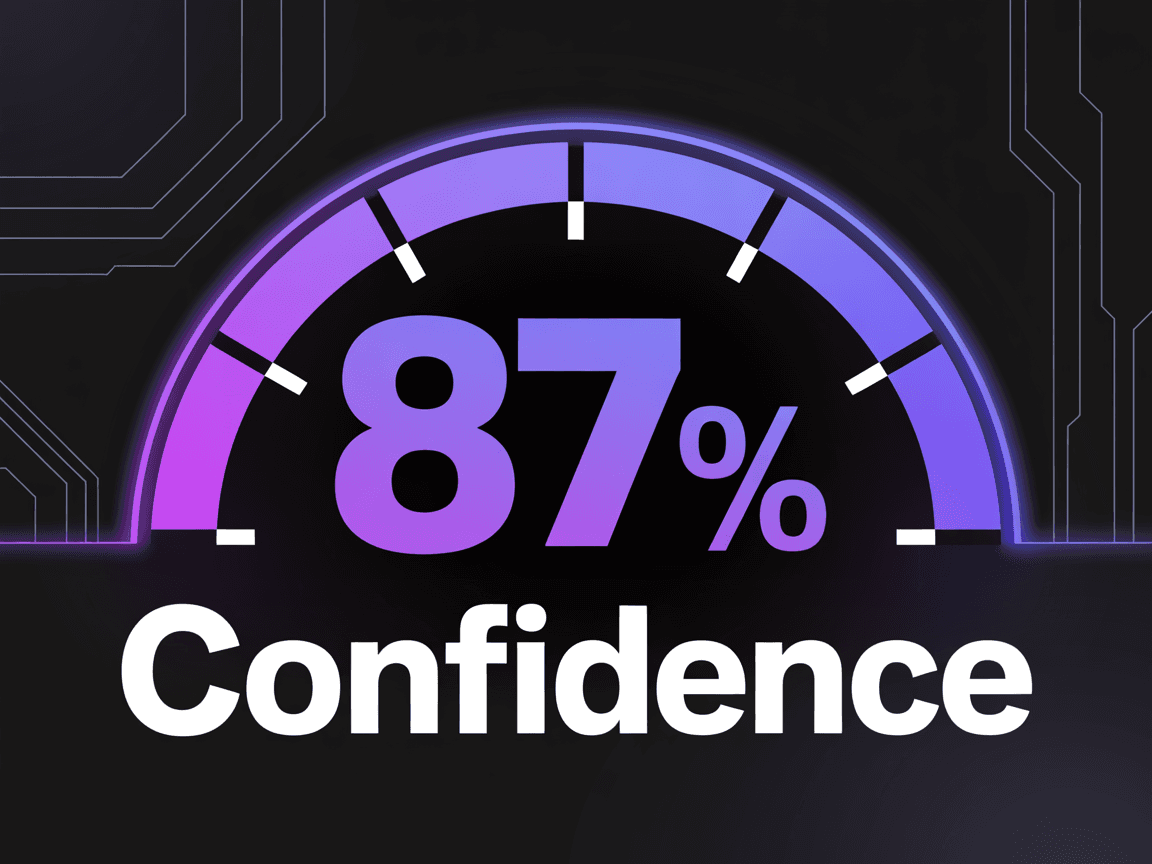
In production, a well-calibrated confidence-based escalation system achieves 85-92% automation rates with error rates at or below human-only baselines. One financial services client we worked with processes 12,000 customer inquiries per day through a confidence-escalation agent. The agent auto-resolves 87% of inquiries, escalates 9% to human agents with full context pre-loaded, and routes 4% to the secondary validation band (of which 70% ultimately auto-resolve). The human agents report that escalated cases arrive with better context than their previous manual triage system provided, reducing their average handling time by 35% even on the cases the agent cannot resolve alone.
Pattern 2: Approval Workflows for High-Stakes Decisions
Some decisions should never be auto-executed regardless of confidence score. Financial transactions above a threshold, customer data deletions, contractual commitments, and regulatory filings all require explicit human approval — not because the agent cannot make good decisions, but because the consequences of a bad decision are asymmetric. A wrong answer on a support ticket costs you a CSAT point. A wrong financial commitment costs you real money and possibly legal liability.
The approval workflow pattern separates agent preparation from agent execution. The agent does 90% of the work — gathering data, analyzing options, drafting the action, validating against business rules — then presents a structured approval request to a human. The human reviews the summary and approves, rejects, or modifies. The agent then executes the approved action.
The architecture centers on an async approval queue. When the agent encounters a high-stakes decision, it writes a structured approval request to the queue containing: the proposed action in plain language, the supporting evidence and data sources, a risk assessment, alternative options considered and why they were rejected, and a recommended approval or rejection with reasoning. The human reviewer sees this as a card in their dashboard — not a raw chat transcript, but a structured decision brief.
SLA-based auto-escalation prevents the approval queue from becoming a bottleneck. Every approval request carries an SLA — typically 15-60 minutes depending on urgency and risk level. If the primary approver does not act within the SLA, the request escalates to a secondary approver. If neither acts, it escalates to a manager with a summary of the delay impact. In our deployments, this three-tier escalation model keeps median approval latency under 8 minutes for standard requests and under 3 minutes for urgent ones.
Batch approval is an efficiency pattern for medium-stakes decisions that arrive in volume. Instead of individual approvals, the agent groups similar decisions and presents them as a batch: "12 refund requests totaling €3,847, all within policy parameters. Approve all / Review individually." This pattern increases approver throughput from 15-20 individual approvals per hour to 80-120 equivalent decisions per hour without reducing decision quality.
One implementation subtlety that matters enormously in practice: the agent should present its recommendation, not just the options. Approval workflows that present neutral options ("Option A, Option B, Option C — choose one") create decision fatigue and slow approvers down. Workflows that present a recommendation with reasoning ("Recommended: Option B because X, Y, Z. Approve?") leverage the agent's analysis while preserving human judgment on the final call. Our data shows that recommendation-first approval interfaces reduce median approval time by 62% compared to option-list interfaces.
For financial services clients, we layer regulatory approval requirements into the workflow. The EU AI Act requires that high-risk automated decisions include an explanation of the decision logic. By building this explanation into the approval request itself, the approval workflow simultaneously satisfies regulatory requirements and helps human reviewers make better decisions. The approval log — including the human's decision and any modifications — becomes the audit trail that compliance teams need.
A European payments processor we work with routes approximately 450 high-value transaction reviews per day through an approval workflow agent. The agent prepares each review with fraud risk analysis, customer history, and regulatory checks. Approval officers process these reviews in an average of 4.2 minutes each — down from 18 minutes under the previous manual process. False positive rates dropped from 12% to 3.8% because the agent's structured analysis catches patterns that human reviewers previously missed during rapid manual review.
Pattern 3: Supervisory Dashboards for Continuous Monitoring
Approval workflows work for discrete, high-stakes decisions. But what about agents that run continuously — processing documents, monitoring systems, managing queues — where the volume makes per-decision approval impossible? This is where supervisory dashboards come in: real-time monitoring interfaces that give humans visibility into autonomous agent operations without requiring them to approve each action.
The supervisory dashboard is not a BI dashboard with charts updated daily. It is an operational control panel with sub-minute data freshness, anomaly detection, and direct intervention controls. Think air traffic control, not quarterly business review.
The dashboard architecture has three layers. The activity stream shows real-time agent actions: what the agent is doing, which systems it is interacting with, and the outcomes of each action. This is not a raw log — it is a semantically summarized feed that groups related actions and highlights notable decisions. A supervisor can scan 200+ agent actions per hour by reading summaries rather than individual transactions.
The anomaly detection layer runs statistical models on agent behavior and flags deviations. These include: output distribution shifts (the agent is suddenly classifying 40% of invoices as disputed when the historical rate is 8%), latency spikes (the agent is taking 3x longer to process requests, suggesting upstream system issues), error rate changes (the agent's retry count has doubled in the last hour), and confidence score drift (the average confidence score has dropped by 15 points, suggesting the input distribution has shifted). Each anomaly triggers a visual alert with severity classification and recommended action.
The intervention controls allow supervisors to act on what they see. At minimum: pause the agent (stop all autonomous actions immediately), restrict scope (disable specific capabilities while keeping others active), override a specific decision (reverse an action the agent took and execute an alternative), and adjust thresholds (tighten or loosen confidence thresholds in real time). These controls must work instantly — not queued for the next deployment cycle. In production, we implement intervention controls as feature flags that take effect within 30 seconds of activation.
One architectural decision we learned the hard way: the dashboard must be independent of the agent's infrastructure. If the agent's systems are experiencing issues — the exact scenario when you most need the dashboard — the dashboard must still function. We deploy supervisory dashboards on separate infrastructure with independent data pipelines that mirror the agent's state rather than querying the agent's systems directly.
For manufacturing clients running quality inspection agents, the supervisory dashboard is the primary oversight mechanism. The agent inspects 2,000-5,000 items per shift autonomously. The quality supervisor monitors through the dashboard, watching for anomaly alerts and reviewing a statistically sampled subset of inspection decisions. If the anomaly detection flags a pattern — say, an unusual distribution of defect classifications that might indicate a camera calibration issue — the supervisor can pause the agent, investigate, and resume once the root cause is addressed. This pattern maintains the throughput benefits of autonomous operation while providing the oversight that EU AI Act governance requirements demand.
Pattern 4: Graceful Degradation — When the Agent Should Stop
The first three patterns address how agents operate under normal conditions. Pattern 4 addresses the scenario that separates production-grade agents from demos: what happens when things go wrong. The agent's model provider has an outage. An upstream API returns corrupt data. The input distribution has shifted so far that confidence scores are meaningless. The agent encounters a novel situation that falls entirely outside its training distribution.
Graceful degradation is the discipline of defining, in advance, the conditions under which an agent should reduce its autonomy level or stop operating entirely — and ensuring it does so without data loss, cascading failures, or silent errors.
Circuit breakers are the first mechanism. Borrowed from microservices architecture, circuit breakers monitor agent error rates and trip when thresholds are exceeded. We implement three circuit breaker levels. Yellow: error rate exceeds 5% over a 10-minute window. The agent continues operating but shifts from Level 4 to Level 3 autonomy — all decisions now require approval. Orange: error rate exceeds 15% or three consecutive critical errors. The agent pauses new work, completes in-flight tasks with human oversight, and alerts the operations team. Red: error rate exceeds 30% or a single catastrophic error (data corruption, unauthorized system access, compliance violation). The agent stops immediately, preserves state for investigation, and falls back to the manual process.
Error budgets provide a longer-horizon mechanism. Similar to SRE error budgets, an agent error budget defines the acceptable cumulative error rate over a rolling period — typically 30 days. If the agent's error rate over the past 30 days exceeds the budget (commonly set at 2-5% depending on the domain), its autonomy level is automatically reduced until performance recovers. This prevents the slow drift scenario where an agent's accuracy degrades gradually enough that circuit breakers never trip, but cumulative impact is significant.
Fallback procedures define what happens when the agent stops. This is the detail most teams skip, and it is the detail that determines whether a circuit breaker trip is a minor operational event or a crisis. For every agent we deploy, we document: the manual process that the agent replaces (who does what, in what order), the handover protocol (how in-flight work transfers from agent to human), the data preservation requirements (what state must be saved and where), and the restart criteria (what conditions must be met before the agent resumes). These procedures are tested quarterly — not just documented.
Boundary definition is the proactive complement to reactive circuit breakers. Rather than waiting for the agent to fail, we explicitly define the boundaries of its capability and program it to recognize when a request falls outside those boundaries. This uses a combination of input classification (is this request type in the agent's training distribution?), complexity scoring (does this request require capabilities the agent does not have?), and stakeholder identification (does this request involve a VIP customer, high-value account, or sensitive topic that warrants human handling regardless of the agent's confidence?).
The most mature deployment we manage — a customer operations agent for a fintech company handling 8,000 interactions daily — has triggered its yellow circuit breaker 7 times in 12 months of operation, its orange circuit breaker twice (both due to upstream API issues, not agent errors), and its red circuit breaker zero times. Each yellow trigger was resolved within 30 minutes. The two orange triggers were resolved within 2 hours. At no point did the fallback to manual processing cause service degradation visible to end customers. That is what graceful degradation looks like in practice: not an absence of problems, but a systematic, pre-planned response to problems that preserves service continuity.
Defining Guardrails Without Killing Effectiveness
The most common failure mode in human-in-the-loop design is not too few guardrails — it is too many. We have seen enterprise deployments where the agent was so constrained by approval requirements, validation checks, and scope limitations that it automated less than 15% of the target workflow. At that point, you have spent €200,000 to build a system that makes existing processes slower, not faster.
The guardrail calibration problem is a manifestation of organizational risk aversion meeting unfamiliar technology. When stakeholders do not trust the agent — which is the default state at launch — they layer on restrictions. Each restriction feels small and reasonable in isolation. In aggregate, they strangle the agent's ability to deliver value.
Our framework for guardrail calibration follows a principle we call "Start tight, measure everything, loosen with data." Here is how it works in practice.
Phase 1: Shadow Mode (Weeks 1-2). The agent processes every request but takes no action. It generates proposed actions that are logged and compared against what humans actually did. This phase produces two critical datasets: the agent's accuracy rate against human decisions, and the distribution of decision types and complexity levels.
Phase 2: Selective Autonomy (Weeks 3-4). Based on Phase 1 data, identify the decision categories where the agent's accuracy exceeds 95% and the consequences of errors are reversible. Enable autonomy for these categories only. Typically, this covers 30-40% of total volume — the routine, well-defined cases.
Phase 3: Expanded Autonomy (Weeks 5-8). Review the escalated cases from Phase 2. For each category that was restricted, evaluate: what was the error rate on escalated cases? What was the cost of errors that did occur? What was the cost of human review? If the expected cost of errors is less than the cost of human review, expand autonomy to that category.
Phase 4: Continuous Calibration (Ongoing). Establish a monthly guardrail review cadence. Review automation rates, error rates, and cost metrics. Adjust thresholds in both directions — loosen where performance warrants it, tighten where new failure modes emerge.
The critical metric in this framework is not accuracy — it is the cost of review versus the cost of errors. A guardrail is justified when the expected cost of the errors it prevents exceeds the cost of the human review it requires. When a guardrail costs more to operate than the errors it prevents, it should be removed.
One practical example: a logistics client initially required human approval for all shipment rerouting decisions, regardless of reason or value. The approval process added 45 minutes of latency to each rerouting, which sometimes caused missed delivery windows. After analyzing four weeks of data, we found that 78% of rerouting decisions were weather-related with a 99.2% agent accuracy rate, and the average cost of an incorrect rerouting (€35 for a correction) was far less than the cost of a 45-minute delay (€120 in SLA penalties). We removed the approval requirement for weather-related rerouting, kept it for other categories, and the agent's effective automation rate jumped from 34% to 71% overnight.
The six-week playbook we use for first deployments builds this calibration process into the implementation timeline, ensuring guardrails are data-driven from day one rather than based on organizational anxiety.
Technical Implementation: Confidence Scoring and Threshold Tuning
Confidence scoring is the technical foundation of Patterns 1 and 4. A poorly implemented confidence scorer creates a system that is either overconfident (auto-executing decisions it should escalate) or underconfident (escalating everything, defeating the purpose of automation). Getting this right requires combining multiple signal sources and calibrating them against real outcomes.
Logprob analysis is the most direct signal for LLM-based agents. Most major LLM providers return log probabilities for generated tokens. The average logprob across the response tokens provides a raw measure of the model's certainty. However, raw logprobs are a weak confidence signal on their own — models can be confidently wrong, especially on out-of-distribution inputs. We use logprobs as one input, weighted at 20-25% of the composite score, and primarily as a filter: responses with very low average logprobs (below -2.5) are nearly always low quality and should be escalated regardless of other signals.
Multi-model consensus is a more robust but more expensive approach. The same input is processed by 2-3 different models (or the same model with different prompts), and the responses are compared for semantic similarity. High agreement between independent model runs correlates strongly with accuracy. In our implementations, we use a primary model (typically Claude for complex reasoning tasks) and a secondary model (typically GPT-4o-mini for cost efficiency) and measure response similarity using embedding-based cosine similarity. Agreement above 0.92 cosine similarity is a strong positive signal; disagreement below 0.75 is a strong negative signal. This approach adds 40-60% to per-decision LLM costs but improves confidence calibration significantly — well worth it for high-stakes domains.
Domain-specific validation checks are the most reliable confidence signals because they are deterministic. These are rule-based checks that verify the agent's output against known constraints: does the proposed action reference a valid customer ID? Is the monetary amount within policy limits? Does the response contain required regulatory disclosures? Are all referenced products in the active catalog? Each validation check that passes adds to the confidence score; each failure subtracts. We typically implement 10-20 domain-specific checks per agent, and they collectively carry 35-40% of the composite confidence weight.
Retrieval quality scoring applies when the agent uses RAG. The quality of retrieved context — measured by relevance score, recency, and source authority — directly impacts response quality. If the top retrieved documents have low relevance scores (below 0.7 on a normalized scale), the agent is likely operating with insufficient context, and confidence should be penalized accordingly.
Threshold tuning is an ongoing process, not a one-time setup. The initial thresholds are set conservatively based on Phase 1 shadow mode data. After that, we use a Bayesian optimization approach to tune thresholds: define the objective function (maximize automation rate subject to error rate constraint), run the agent with current thresholds for a measurement period, collect labeled outcomes, update the threshold using a Gaussian process model, and iterate. In practice, this means thresholds shift every 2-4 weeks during the first three months and stabilize to monthly or quarterly adjustments thereafter.
One critical implementation detail: confidence scores must be calibrated, not just computed. A raw confidence score of 0.85 is meaningless unless you know that 85% of decisions with that score are actually correct. We use isotonic regression to calibrate raw scores against observed outcomes, producing calibrated probabilities that accurately reflect true accuracy rates. Calibration is recomputed weekly during early deployment and monthly in steady state.
Decision Matrix: Choosing the Right Pattern for Your Use Case
With four patterns in hand, the practical question is: which one do you use? The answer depends on three primary factors — decision risk level, transaction volume, and regulatory constraints — and two secondary factors — latency requirements and organizational maturity with AI.
Financial Services: Pattern 2 (Approval Workflows) + Pattern 3 (Supervisory Dashboards). Financial decisions carry high regulatory risk and material financial consequences. Low-value, high-volume transactions (payment processing, routine account updates) run through supervisory dashboards at Level 4 autonomy. High-value transactions, lending decisions, and compliance-sensitive actions route through approval workflows at Level 3. The EU AI Act classifies creditworthiness assessment as high-risk, mandating human oversight for any AI-driven credit decisions. Our financial services clients typically achieve 70-80% overall automation with this dual-pattern approach.
Customer Support: Pattern 1 (Confidence Escalation) + Pattern 4 (Graceful Degradation). Support operations are high-volume with variable complexity. Confidence-based escalation handles the spectrum naturally: routine queries auto-resolve, complex queries escalate. Graceful degradation protects against model outages and edge cases that could damage customer relationships. For customer operations deployments, we target 75-85% automation with sub-5-minute escalation latency for human-routed cases.
Manufacturing: Pattern 3 (Supervisory Dashboards) + Pattern 4 (Graceful Degradation). Manufacturing agents — quality inspection, predictive maintenance, supply chain optimization — operate in physical environments where errors have safety implications. Supervisory dashboards provide continuous visibility to operations managers. Graceful degradation ensures that equipment safety is never compromised by agent failure. The emphasis here is on anomaly detection speed: manufacturing dashboards must alert within seconds, not minutes.
SaaS Operations: Pattern 1 (Confidence Escalation) + Pattern 2 (Approval Workflows). SaaS onboarding and churn prevention agents handle a mix of routine automation (email sequences, configuration tasks) and high-stakes actions (account modifications, contract changes). Confidence escalation covers the routine work; approval workflows gate the actions with revenue implications. This combination delivers the onboarding acceleration that SaaS companies need while maintaining control over customer-facing commitments.
Decision factors checklist. For any use case not listed above, evaluate along these dimensions:
- Risk level per decision: Low risk favors Pattern 1 or 3. High risk favors Pattern 2. Safety-critical favors Pattern 3 + 4.
- Decision volume: Under 100/day — Pattern 2 is practical. Over 1,000/day — Pattern 1 or 3 is necessary. Over 10,000/day — Pattern 1 with aggressive threshold tuning.
- Latency tolerance: If decisions must be sub-second, Pattern 2 is ruled out. Pattern 1 with pre-computed confidence is the fastest.
- Regulatory requirements: EU AI Act high-risk classification mandates documented human oversight — Pattern 2 or 3 with full audit logging.
- Organizational AI maturity: Low maturity — start with Pattern 2 everywhere and graduate to Pattern 1 or 3 as confidence grows. High maturity — deploy the optimal pattern per use case from day one.
Most enterprise deployments use 2-3 patterns simultaneously for different decision types within the same agent. The agent framework should support pattern switching at the decision level, not the system level. When we architect agent systems for clients, the pattern selection is a configuration parameter per decision type, allowing the same agent to route a routine classification through confidence escalation while sending a financial commitment through an approval workflow — all within a single customer interaction.
If you are evaluating how these patterns apply to your specific use case, contact our engineering team for a design review. We offer a complimentary 90-minute architecture session for enterprise teams planning their first production agent deployment.